WooCommerce fraud prevention is the practice of spotting, stopping, and cleaning up fraudulent orders on a WooCommerce store. In practice it splits into two camps: risk-scoring tools that catch unknown fraud at scale, and block-list tools that stop known offenders you have already identified. Most stores need a bit of both.
If you run a store long enough, you’ll meet fraud face to face. A flood of test orders at 3 a.m. A “customer” who keeps coming back under a new name after every chargeback. A card that clears, ships, and then gets disputed three weeks later. None of it feels abstract once it’s draining your time and your margin.
The good news? You don’t need an enterprise risk team to handle most of it. You just need to know which problem you actually have, then reach for the right tool. In this guide, we’ll walk through the whole WooCommerce fraud prevention workflow, from reading the signals to choosing between scoring and blocking.
Table of Contents
What WooCommerce Fraud Actually Looks Like
Fraud on a WooCommerce store rarely arrives labeled. It shows up as ordinary-looking orders that turn out to be expensive. Knowing the common shapes helps you react faster.
Card-testing is the most familiar one. Bots run small transactions to check which stolen card numbers still work, leaving you with a pile of tiny orders and a stack of gateway fees. Stolen-card fraud is the next tier up: a real, working card buys real goods that ship before the rightful owner disputes the charge. Then there’s friendly fraud, where a genuine customer claims an order never arrived to claw back the money. And there are the repeat offenders, the people who abuse a promo, get refunded, and come straight back for another go.
The scale here is not small. Juniper Research put global eCommerce fraud at $44.3 billion in 2024, with losses forecast to climb to $107 billion by 2029. The U.S. Federal Trade Commission logged $12.5 billion in reported fraud losses in 2024 alone, a 25% jump on the year before. Those numbers are the backdrop to every “it’s just a few weird orders” conversation.
What we’ve seen: the stores that get hurt worst aren’t the ones with the most fraud. They’re the ones that treat every fraudulent order as a one-off surprise. Once you name the pattern you’re dealing with, the response gets a lot simpler.
The Two Camps Of Fraud Prevention
Almost every WooCommerce fraud prevention tool falls into one of two camps. Picking the wrong camp for your problem is one of the most common mistakes store owners make.
Risk-scoring tools for unknown fraud
The first camp scores orders you’ve never seen before. These tools assign a risk value to each incoming order based on signals like geolocation, proxy or VPN use, email reputation, shipping-versus-billing mismatches, card checks, and how fast orders are coming in. Above a threshold, the order gets held or blocked automatically.
FraudLabs Pro is a well-known example, scoring orders through an external API against signals like geolocation, proxy, email, shipping address, card, and transaction velocity, plus a global blacklist. YITH WooCommerce Anti-Fraud takes a rules-and-points approach, where each suspicious trait adds points and a threshold auto-flags high-risk orders. OOPSpam leans on machine learning for spam and fraud, with country, IP, and VPN filtering. These tools shine when your problem is volume from strangers you can’t predict.
Scoring has a real cost, though: false positives. A legitimate customer traveling abroad, using a VPN, or shipping a gift to a different address can trip the rules and get blocked. That’s lost revenue from good buyers, and it’s the trade-off you accept for catching the unknown.
Block-list tools for known offenders
The second camp does something narrower and more certain. A block-list tool stops orders from people you have already identified by name or email. There’s no scoring, no probability, no guessing. If the order matches an entry on your list, it’s blocked. If it doesn’t, nothing happens.
This is exactly the job Checkout Guard was built for.
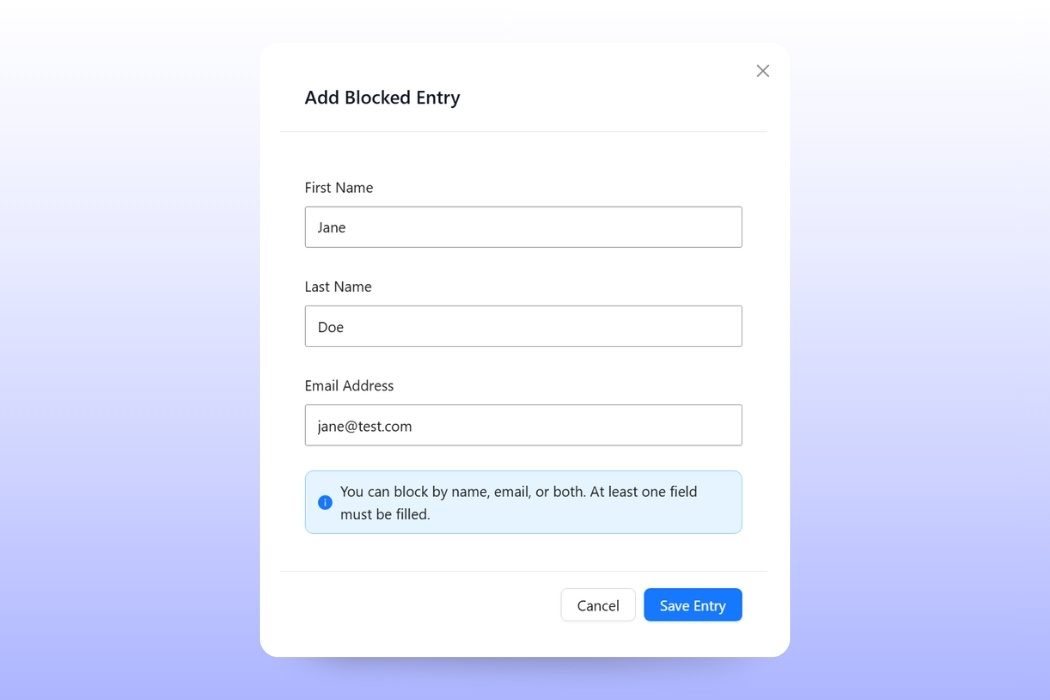
You add an entry using a billing first name and last name and/or an email address. When an incoming order’s billing details exactly match an entry, Checkout Guard blocks it: the order is stopped, the cart is emptied, and the shopper sees a denial message you write yourself. It works on both the classic checkout and the newer Block (Store API) checkout.
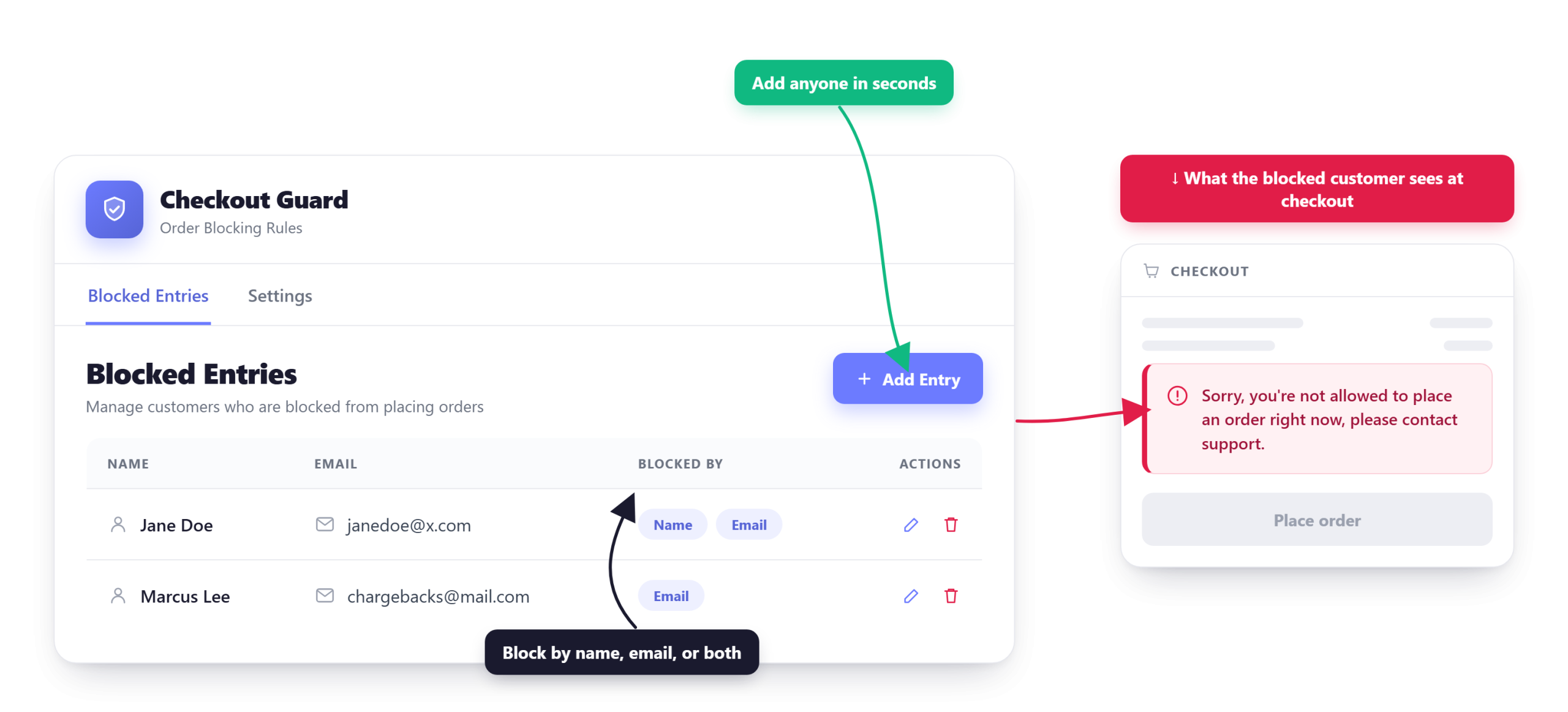
It’s a manual, deterministic list, so it blocks the specific people you’ve decided to keep out and leaves everyone else alone.
The strength of a block list is precision. Zero false positives on anyone who isn’t on the list. No external API to depend on, nothing to tune, no per-order limits. The flip side is the limit: it only stops people you’ve already named, and it won’t detect new fraud on its own. That’s by design.
| Approach | Risk-scoring tools | Block-list tools |
|---|---|---|
| Best for | Unknown fraud at scale | Known, named repeat offenders |
| How it works | Scores each order on signals like geolocation, proxy use, and velocity, then blocks above a threshold | Exact match on the billing name or email you’ve added to a list |
| Catches new fraud? | Yes, including fraud you’ve never seen | No, only people you’ve already identified |
| False positives | Possible (a good buyer can trip the rules) | None beyond the names you chose yourself |
| Example tools | FraudLabs Pro, YITH WooCommerce Anti-Fraud, OOPSpam | Checkout Guard |
How To Run WooCommerce Fraud Prevention In Practice
Tools are only half the job. The workflow around them is what keeps fraud from eating your week. Here’s a routine worth setting up on any store.
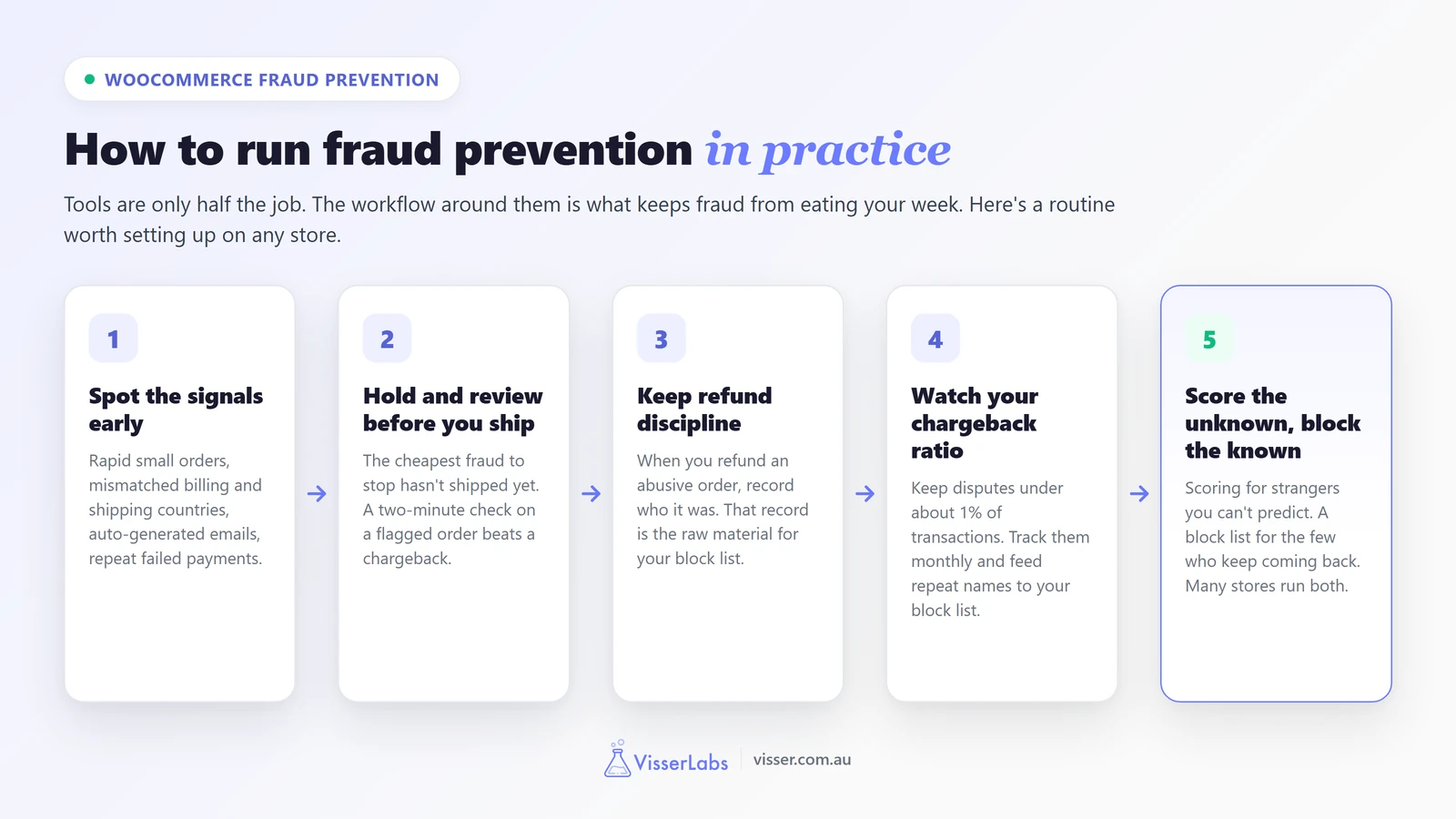
Spot the signals early
Train yourself and your team to flag the obvious tells: a string of small orders in minutes, mismatched billing and shipping countries, email addresses that look auto-generated, or multiple failed payments before one clears. None of these prove fraud on their own. Together, they’re worth a second look before anything ships.
Hold and review before you ship
The cheapest fraud to stop is the order that hasn’t shipped yet. For physical goods, build in a short review window on flagged orders. A two-minute manual check on a suspicious order beats a chargeback fee and lost stock every time. Scoring tools automate this triage; on a smaller store, a human eye on flagged orders works fine.
Keep refund discipline
Refunds are where repeat offenders make their money. When you refund a clearly fraudulent or abusive order, record who it was. Don’t just process the refund and move on. That record is the raw material for your block list, and it’s how a one-time problem stops becoming a recurring one.
Watch your chargeback ratio
Beyond the cost of any single dispute, your chargeback ratio is a number your payment processor watches closely. Most card networks expect it to stay under about 1% of transactions, and crossing that line repeatedly can trigger fees, mandatory monitoring programs, or even losing your ability to take cards at all. So every prevented fraudulent order counts twice: once for the saved goods, and again for keeping your ratio healthy. Track disputes monthly, note which orders caused them, and feed the repeat names straight into your block list.
Score the unknown, block the known
This is the core decision. If your problem is a flood of orders from strangers you can’t predict, you want scoring. If your problem is a handful of specific people who keep coming back, you want a block list. The two aren’t rivals; they cover different threats. A busy store fighting card-testing bots and a few known abusers might reasonably run both.
For most small and mid-sized stores, the real, recurring pain is the known offender, not the statistical unknown. The Merchant Risk Council’s 2024 Chargeback Field Report found merchants reporting an 18% average rise in friendly fraud over three years, and a lot of that comes from the same faces returning. When that’s your problem, an enterprise scoring stack is overkill and false-positive-prone. A direct block list solves it cleanly.
If you’ve already got a short list of names and emails you never want to see again, adding them to Checkout Guard takes a couple of minutes and stops them at the door from then on.
Choosing Your Setup
Your WooCommerce fraud prevention setup depends entirely on which problem dominates your store. Use this as a starting frame.
If you’re a small or mid-sized store and your main pain is a few repeat offenders, abusers, or a specific person you need to stop, a block list is the simplest, most reliable answer. It’s deterministic, it’s quick to set up, and it won’t ever block a good customer by accident.
If you’re processing high volume and getting hit by unpredictable, large-scale fraud from people you can’t identify in advance, lead with a scoring tool and accept that you’ll tune out some false positives over time.
And if you’re somewhere in between, which most growing stores are, the pragmatic move is a scoring tool for the unknown plus a block list for the known names that scoring keeps missing or waving through. Clean order management habits, covered in our WooCommerce order handling guidance, tie the whole thing together.
Put A Plan In Place This Week
You don’t need a fraud team to protect a WooCommerce store. You need to know which problem you have and match it to the right camp. Here’s a quick recap of what we covered:
- Know what fraud looks like so you can react before it ships.
- Understand the two camps: scoring for unknown fraud, block lists for known offenders.
- Run the practical workflow: spot signals, review, refund with discipline, score or block.
- Choose the setup that fits your store’s real, dominant problem.
If you’re ready to put your WooCommerce fraud prevention plan into action, start with the threat that’s actually costing you. If that’s known repeat offenders, the fastest fix is
Frequently Asked Questions
What’s the difference between fraud scoring and a block list?
Fraud scoring assigns a risk value to every incoming order using signals like geolocation, proxy use, and velocity, then blocks orders above a threshold. It catches fraud you haven’t seen before, at the cost of occasional false positives. A block list does the opposite: it blocks only the specific names or emails you’ve already identified, with no guessing and no false positives on anyone else.
Do I need both a scoring tool and a block list?
Not always. If your problem is a few known repeat offenders, a block list alone usually does the job. If you’re hit by large-scale fraud from strangers, you need scoring. Many growing stores run both, using scoring for the unknown and a block list for the known names that keep slipping through.
Can Checkout Guard detect suspicious orders automatically?
No, and that’s intentional. Checkout Guard is a manual, deterministic block list. It blocks orders whose billing name and/or email exactly match an entry you’ve added. It doesn’t score, profile, or detect anything on its own. You decide who gets blocked, and it enforces that decision reliably on both classic and Block checkout.
Will a block list accidentally block real customers?
Only if a real customer’s billing name or email exactly matches an entry you put on the list. Because Checkout Guard matches on exact details you’ve chosen yourself, it won’t block anyone you haven’t deliberately added. That’s the key advantage over scoring tools, which can flag legitimate buyers who happen to look risky.
How do I stop the same person ordering after a chargeback?
Record the billing name and email from the fraudulent order at the time you process the refund, then add those details to a block list. From then on, any new order matching that name or email is blocked automatically before it can be placed. This is the most reliable way to break the refund-and-return cycle with a specific offender.
Is WooCommerce fraud prevention worth it for a small store?
Yes. WooCommerce fraud prevention pays for itself even on a small store. The FTC reported $12.5 billion in fraud losses in 2024, up 25% year over year, and small stores aren’t exempt. Even a handful of chargebacks carries fees, lost stock, and wasted time, so a focused setup, often just a block list for known offenders, earns its keep quickly without the overhead of an enterprise system.